A dumbbell chest workout builds your pecs with pressing and fly movements across three angles (flat, incline, and decline), and you can run it with a full bench or with nothing but the floor. This guide walks through each exercise with form cues, shows you how to bias your upper, lower, and inner chest, gives no-bench and at-home options, and ends with weight-selection rules and a sample workout you can repeat weekly.
Key Takeaways
- Exercise order beats variety. Press heavy first (flat, then incline), then finish with flyes and squeeze work. Swapping exercises every week is what stalls most chest progress.
- For upper chest, keep the incline low at 15–30°. A steeper bench shifts the load to your front delts, which is the most common upper-chest mistake.
- You do not need a bench. Floor presses, floor flyes, and standing presses train the same muscle, and the floor caps the stretch on a fly, which protects the shoulder.
- Progress by adding reps first, then load. Hitting the top of your rep range on every set is the signal to go heavier, not a calendar date.
- On flyes, keep your hands under your shoulders to load the chest. Letting them drift over the shoulders turns the movement into delt work.
- Flyes and squeeze presses are accessories, not mass builders. Go lighter and slower for tension rather than chasing heavier weight.
- Training for time (40-second sets with short rest) is a workable home method when your dumbbells are too light to load heavy.
Why dumbbells work so well for chest
Dumbbells let each arm move on its own path, so you get a deeper stretch at the bottom, you correct side-to-side strength gaps, and your stabilizers work harder than they do on a fixed bar. That extra range and independent loading is the main reason dumbbells are a genuine chest builder, not a downgrade from the barbell. A 2017 study in the Journal of Strength and Conditioning Research (Farias and colleagues) found dumbbell pressing produced greater pectoralis activation than a barbell or machine during the same movement. Earlier work by Saeterbakken and Fimland (2011) showed dumbbell pressing demands more shoulder and core stabilization than more supported variations, which is part of why it carries over well to real strength.
The best dumbbell chest exercises (with form cues)
These seven movements cover every part of the chest. Learn the cues once, then pull the ones you need into the sample workout further down.
Flat dumbbell bench press
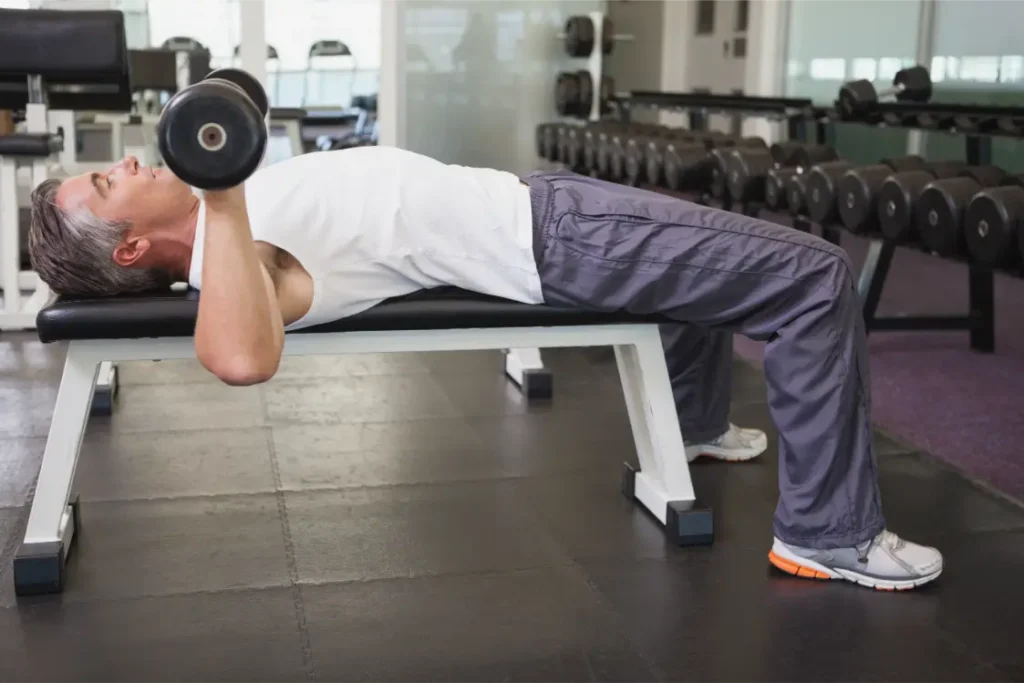
This is your foundation and the lift you will load heaviest. Lie back with a dumbbell in each hand at chest level, palms facing forward, and press until your elbows lock, keeping your upper arms about 45 degrees from your torso. Lower under control until the dumbbells reach the sides of your chest. The common mistake is flaring your elbows straight out to 90 degrees, which shifts stress onto the shoulder instead of the pec.
Incline dumbbell press (upper chest)
The incline press is the main driver for your upper chest. Set the bench between 15 and 30 degrees, with 30 as the sweet spot, then press as you would on the flat version. Going steeper feels harder but sends the work to your front delts, so resist the urge to sit the bench up to 45 degrees. If your shoulders have wear on them, the lower angle is also the more comfortable choice.
Dumbbell floor press (no bench, shoulder-friendly)
The floor press gives you a heavy chest press with no bench at all. Lie on the floor with your knees bent, press the dumbbells up, and lower until the backs of your upper arms touch the ground, pause, then drive up. The floor caps your range, which takes pressure off the shoulder and builds lockout strength. Done one arm at a time, it also exposes and fixes strength gaps between sides. For how it stacks up against a bench version, HiTONE covers the learn other differences.
Dumbbell fly (flat, incline, or floor)
The fly isolates the chest by taking the triceps out of the movement. Keep a soft, fixed bend in your elbows, lower your arms out in an arc until you feel a stretch across the chest, then squeeze them back together over your chest. Keep your hands tracking under your shoulders; when they drift up over the shoulders, the delts take over. Research on the fly (Solstad and colleagues, 2020) confirms it as a strong pec-focused movement. If your shoulders feel exposed at the bottom on a bench, do the fly lying on the floor instead, so the ground stops the stretch before it becomes a strain.
Close-grip squeeze press (inner chest)
This one hammers the inner chest and is gentle on the shoulders. Press two dumbbells together with a neutral grip and keep pressing them into each other the entire set, up and down. The constant inward squeeze lights up the inner pec from the first rep. The mistake is letting the dumbbells drift apart at the top, which drops the tension the exercise is built on. Hex dumbbells make the squeeze easier to hold.
Dumbbell pullover
The pullover adds a stretch through the chest and lats and needs only one dumbbell. Hold a single dumbbell over your chest with both hands, keep a slight bend in your elbows, and lower it back behind your head in an arc until you feel a deep stretch, then pull it back over your chest. Keep your ribs down and avoid arching your lower back to reach further. Go lighter than you think, since the stretched position is where the shoulder is most vulnerable.
Standing dumbbell press and fly (no equipment, standing)
When you have no bench and no floor space, you can still train chest standing. Press two dumbbells together out in front of your chest (a squeeze-press pattern), or raise them in a controlled upward fly, bracing your core the whole time. The mistake to avoid is leaning back and using momentum to swing heavier weight; keep the torso still and let the chest do the work.
How to target a specific part of your chest
The pec is one muscle, but changing the angle biases different regions. Here is which movements to reach for depending on your goal.
Upper chest with dumbbells
Lead with the incline press at 15–30 degrees, and add an incline fly to finish. The lower incline keeps tension on the upper pec (the clavicular fibers) without handing the work to your shoulders, which is exactly what happens when the bench gets too steep.
Lower chest with dumbbells
Use a decline press, or mimic one with a floor press while you bridge your hips up. A slightly deeper fly arc also biases the lower fibers. You do not need a decline bench to train the lower chest; the hip-bridged floor press covers it.
Inner chest with dumbbells
The close-grip squeeze press is your best inner-chest tool, and squeezing the dumbbells together hard at the top of every fly adds to it. The inner pec responds to that hard adduction at the midline, which a normal press does not force.
No bench or training at home? Do this
You can build a full chest with dumbbells alone, no bench required. Swap the bench presses for floor presses, do your flyes on the floor, and add standing presses and push-up variations (feet on the floor, hands on the dumbbells for a deeper stretch, or diamond push-ups for the inner chest). With a single pair, the pullover, single-arm floor press, and standing squeeze press cover most angles. If your dumbbells are on the light side, run each exercise for time, roughly 40 seconds with short rest, so fatigue does the work that heavy weight would. If you have a heavier and a lighter pair, you can push a set to failure and drop straight to the lighter pair to keep going.
How to choose your dumbbell weight
Use a simple rule to stop guessing and avoid stalled progress.
| What happens | What it means | What to do |
|---|---|---|
| You hit the top of the rep range on all sets | Load is manageable | Increase weight next session |
| Reps drop sharply after set one | Weight is too heavy | Reduce load and keep form strict |
| Shoulders feel stressed | Poor setup or angle | Adjust elbow path or bench angle |
Substitutions when equipment or joints get in the way
| Problem | Substitution | Why it works |
|---|---|---|
| Flat bench unavailable | Dumbbell floor press | Limits shoulder strain while allowing heavy loads |
| Incline press hits shoulders | Lower incline or neutral-grip press | Keeps stress on chest instead of delts |
| Need more lower-chest focus | Slight decline or deeper flye arc | Targets lower fibers without extra volume |
The barbell bench press is another option worth weighing. Learn how the two compare.
A sample dumbbell chest workout
Run this once or twice a week. If twice, drop the load slightly on the second session and focus on clean reps. Use the bench version if you have one, or the home version if you do not.
Bench version
| Exercise | Sets | Reps | Rest |
|---|---|---|---|
| Flat dumbbell bench press | 4 | 6–10 | 2–3 min |
| Incline dumbbell press (15–30°) | 3 | 8–12 | 90–120 sec |
| Dumbbell fly | 3 | 10–15 | 60–90 sec |
| Dumbbell pullover | 2–3 | 10–12 | 60–90 sec |
| Close-grip squeeze press (finisher) | 2 | 12–20 | 45–60 sec |
Home or no-bench version
| Exercise | Sets | Work | Rest |
|---|---|---|---|
| Dumbbell floor press | 4 | 8–12 reps | 90 sec |
| Floor fly | 3 | 10–15 reps | 60 sec |
| Deficit push-up (hands on dumbbells) | 3 | 40 sec | 45 sec |
| Standing squeeze press | 3 | 12–15 reps | 45 sec |
| Diamond push-up (inner chest) | 2 | 40 sec | 45 sec |
How to fit this into your week
| Day | Focus | Notes |
|---|---|---|
| Day 1 | Upper body | Run this chest workout first |
| Day 2 | Lower body | Squats, hinges, lunges |
| Day 3 | Rest or cardio | Optional recovery work |
Chest pressing also trains your triceps, so pair this with a dedicated dumbbell triceps workout and some dumbbell forearm exercises to round out your upper-body dumbbell training.
FAQs
How many dumbbell chest exercises should you do in one workout?
Two to four movements per session covers the chest without junk volume. Use one or two presses for strength and size, then one or two flyes or squeeze presses for tension and detail. More exercises than that usually means each one gets your worst effort.
How often should you train chest with dumbbells?
Twice a week is a reliable starting point for most people, with at least a day between sessions. You do not need full muscle recovery before training again; steady weekly volume drives more growth than one all-out day. Adjust up or down based on how your shoulders and joints feel.
What weight dumbbells should a beginner use for chest?
Start light enough to finish every rep with clean form and two to three reps still in the tank. For most beginners that means a pair they can press for 10 to 12 controlled reps. Add weight only once you hit the top of that range on all your sets.
Final Thoughts: Your Dumbbell Chest Workout
A dumbbell chest workout that you can load progressively, repeat weekly, and adjust without changing exercises every session is what builds a stronger, fuller chest, whether you train in a gym or at home with a single pair. If you want help dialing in form, load selection, or a weekly structure that fits your schedule, working with a personal trainer can be the difference between steady progress and stalled results.