
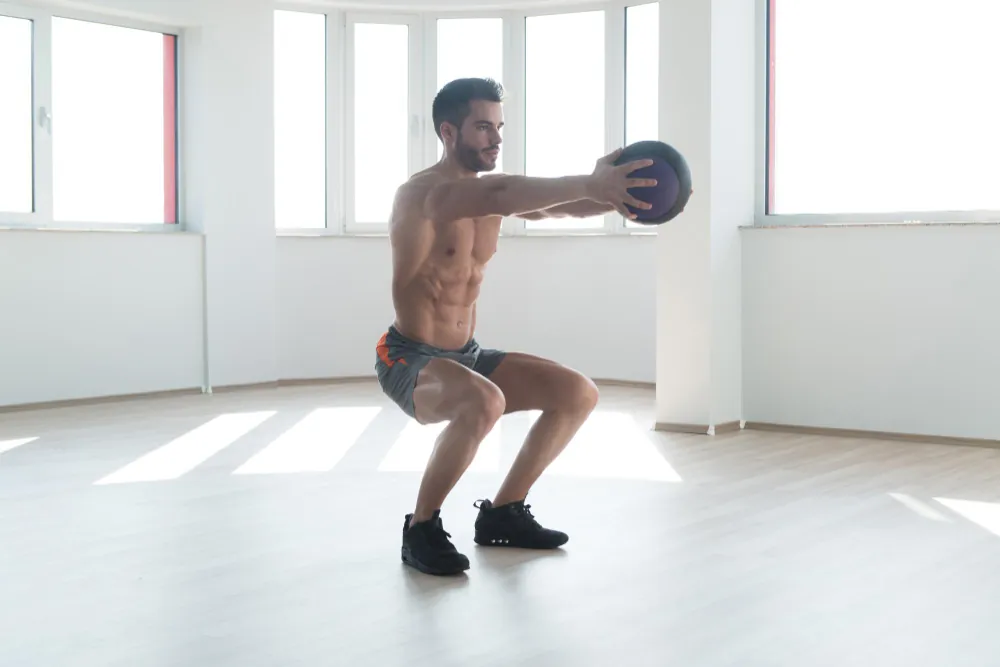
If bodyweight squats no longer challenge you, it’s time to level up with squats with a medicine ball. Adding a medicine ball instantly increases resistance and forces your body to work harder to stay balanced and controlled. It’s a simple change that turns a basic move into a full-body workout.
Key Takeaways
Squats with a medicine ball are a simple but powerful way to make your leg workouts more effective and engaging.
- Adding a medicine ball increases resistance and activates your core, shoulders, and upper back.
- Focus on good form: keep your chest up, core tight, and knees in line with your toes.
- Start with the basic version, then progress to variations like overhead or jump squats for more challenge.
- A light to moderate ball (4-12 pounds) works best for control and full range of motion.
- Medicine ball squats are ideal for home workouts, functional strength, and improving stability and coordination.
How to Do Squats with a Medicine Ball (Step-by-Step)
Here’s how to perform a proper medicine ball squat with control and good form:
- Stand Tall: Place your feet shoulder-width apart and hold the medicine ball close to your chest with both hands.
- Engage Your Core: Tighten your abs to keep your spine stable and upright.
- Lower into a Squat: Push your hips back and bend your knees, lowering yourself until your thighs are parallel to the floor (or as low as comfortable).
- Keep Your Chest Up: The ball will naturally help you maintain an upright posture — avoid rounding your back.
- Drive Through Your Heels: Push through your heels to return to the starting position, keeping your knees in line with your toes.
- Repeat: Perform 10-15 reps for 2-3 sets, depending on your fitness level.
Form Tips:
- Keep your weight evenly distributed across your feet.
- Avoid letting your knees cave inward.
- Breathe in as you lower and out as you rise.
Variations of Medicine Ball Squats
Once you’ve mastered the basic version, try these variations to target different muscles and add variety to your routine.
Basic Medicine Ball Squat
- Hold the ball at chest level and perform a standard squat.
- Focus on control and posture.
Wall Squat with Medicine Ball
- Stand with your back against a wall and place the ball between your lower back and the wall.
- Squat down slowly, keeping the ball in place, then return to standing.
Overhead Medicine Ball Squat
- Hold the ball overhead with both hands.
- Keep your arms extended as you squat down and return to standing.
Medicine Ball Front Squat
- Hold the ball slightly in front of your chest instead of tight to it.
- Keep your elbows up and back straight as you lower.
Medicine Ball Jump Squat
- Hold the ball close to your chest.
- Perform a deep squat, then explode upward into a jump. Land softly and go straight into the next rep.
Medicine Ball Slam-to-Squat Combo
- Hold the ball overhead, slam it to the ground, catch it on the rebound, and immediately go into a squat.
- Repeat continuously with rhythm and control.
FAQ
Are squats with a medicine ball good for beginners?
Yes. They’re a great next step once you’re comfortable with bodyweight squats. Start with a light ball (4-8 pounds) and focus on maintaining proper form before increasing the weight or adding variations.
What muscles do squats with a medicine ball work?
They primarily target the quads, glutes, and hamstrings, but also engage the core, shoulders, and back. Holding the ball adds upper-body involvement and helps reinforce good posture throughout the movement.
Are medicine ball squats safe for the knees and back?
Yes, as long as you keep proper form. Feet shoulder-width apart, knees tracking over toes, and chest upright.