
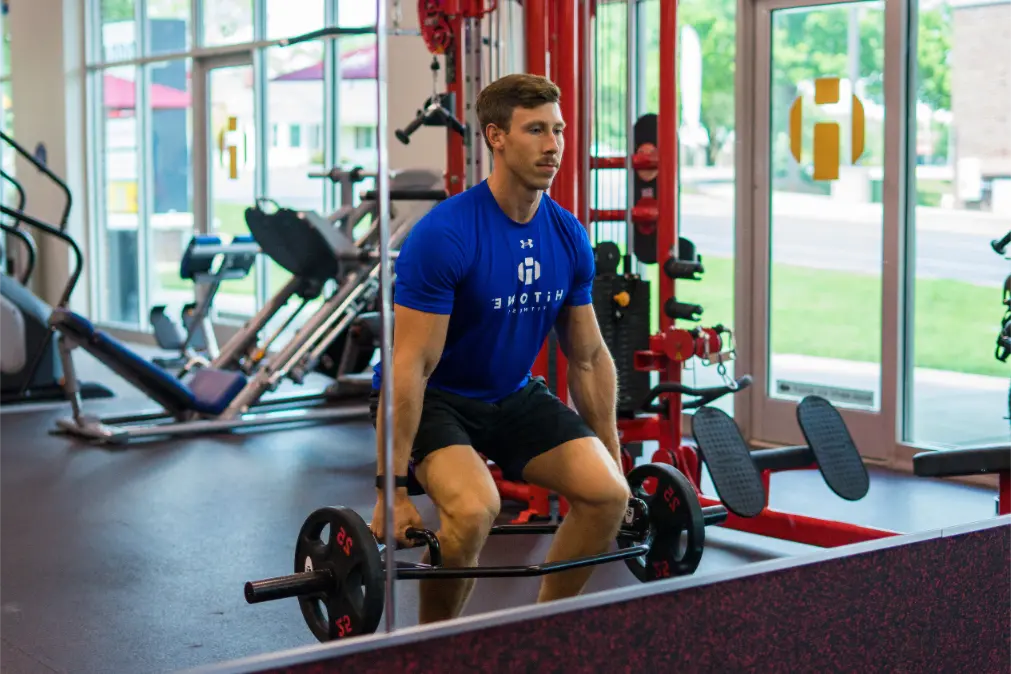
By Blair Dykes, Personal Trainer at HiTone Fitness South Congaree, former competitive dancer and bodybuilder.
A HIIT leg workout alternates short, hard bursts of lower-body exercise with brief rest, training your quads, hamstrings, glutes, and calves while keeping your heart rate high. The work-to-rest structure builds lower-body strength and burns calories in less time than a steady gym session, because your muscles and your cardiovascular system both stay under load.
Key Takeaways
- Beginners should start with bodyweight moves and even work-to-rest intervals, then add load only once their form holds under fatigue.
- Form breaks down as you tire, and that is when most leg injuries happen, so end a set early rather than grind out sloppy reps.
- Equipment is optional. Dumbbells, kettlebells, or resistance bands add resistance, but bodyweight plyometrics like jump squats already deliver a HIIT stimulus.
- Two leg-focused HIIT sessions a week sit well alongside other training, since legs need recovery days to rebuild.
- Progress by cutting rest, adding weight, or choosing harder movements, not by piling on endless extra rounds.
- Recovery is part of the program. Stretching, foam rolling, and rest days are what let the work turn into stronger legs.
Why HIIT Works for Your Legs
HIIT works your legs because compound moves like squats, lunges, and deadlifts load several muscle groups at once, and the interval format stacks a cardio demand on top of that strength work. Explosive moves such as jump squats and box jumps recruit fast-twitch fibers for power, while the minimal rest keeps your heart rate up so you train strength and conditioning together. You can finish a full lower-body session in 15 to 30 minutes. Training strength and conditioning in the same session is what makes HIIT efficient for leg day.
How to Prepare for a HIIT Leg Day
Good preparation comes down to two things: the right warm-up and enough support for high-impact movement. You need little gear to start.
What Equipment Do You Need?
You can run every routine below with no equipment, but a few items add resistance and comfort:
- Weights: Adjustable dumbbells or kettlebells add resistance to your workouts.
- Resistance bands: Useful for adding challenge to exercises like squats and lunges.
- A good pair of shoes: Proper footwear provides support and cushioning for high-impact movements.
- Mat: For comfort and support during floor exercises and stretches.
Warm-Up and Safety Basics
Warm up for 5 to 10 minutes before any HIIT leg session to prime your muscles and joints for explosive work. Then keep these basics in mind:
- Warm up properly: Spend 5 to 10 minutes on light cardio and dynamic stretches before your first hard interval.
- Use proper form: Hold correct technique to avoid strain, especially once fatigue sets in during high-intensity intervals.
- Stay hydrated: Keep water nearby and drink before, during, and after your workout.
Sloppy form under fatigue is the fastest way to hurt a knee or ankle, so slow down before your technique slips.
For a full guide with video instructions, read our 30-minute leg workout article.
3 HIIT Leg Workout Routines
Pick the routine that matches your level. Each one cycles work and rest, and you repeat the full circuit for the number of rounds listed. Start one level below where you think you are if you are new to high-impact training.
If jumps bother your knees, swap them for the low-impact version: replace jump squats with bodyweight squats, and box jumps with step-ups.
Beginner HIIT Leg Routine
Move through each exercise, then rest as noted. Focus on clean form over speed.
- Squat pulses, 30 seconds
- Rest, 30 seconds
- Alternating lunges, 30 seconds
- Rest, 30 seconds
- High knees, 30 seconds
Rest for one minute, then repeat the circuit three times.
Intermediate HIIT Leg Routine
Add load and speed once the beginner circuit feels controlled.
- Jump squats, 30 seconds
- Rest, 20 seconds
- Walking lunges with dumbbells, 30 seconds
- Rest, 20 seconds
- Mountain climbers, 30 seconds
Rest for one minute, then repeat for four rounds. Increase the challenge by adding weight or moving faster while keeping your form.
Advanced HIIT Leg Routine
Use this circuit only once you can hold form through fatigue and land jumps softly.
- Single-leg deadlifts with a kettlebell, 30 seconds each side
- Rest, 15 seconds
- Burpee to box jump, 30 seconds
- Rest, 15 seconds
- Tuck jumps, 30 seconds
Rest for 45 seconds, then complete five cycles. Land every jump with soft knees and your weight in your heels to protect your joints at this intensity.
For a plan built around your goals and fitness level, the personal trainers at HiTone Fitness South Congaree can tailor your HIIT sessions and progressions.
Also, see how StairMaster HIIT workout helps you burn calories faster.
How to Make Your Leg HIIT Harder Over Time
Make your leg HIIT harder by adding load, shortening rest, or picking more demanding movements once a routine stops feeling challenging. Balance it with other training for steady leg development. Adding steady-state cardio such as jogging or cycling twice a week builds cardiovascular endurance without overloading your legs, and dedicated strength sessions with deadlifts and leg presses help you build muscle and recover.
When Should You Increase the Intensity?
Step up the intensity once your current routine feels controlled and you can finish every round with clean form. From there, you can:
- Increase the duration or speed of active intervals
- Decrease the rest periods
- Add resistance or weights
- Bring in more complex movements
Change one variable at a time so you can tell what is driving your progress and avoid jumping too far too fast.
How to Recover After a HIIT Leg Workout
Recovery is when your legs adapt and get stronger, so treat it as part of the workout rather than an afterthought.
- Cool down and stretch: Allocate time after your workout to cool down, then stretch the quadriceps, hamstrings, calves, and glutes to reduce tightness and support flexibility.
- Foam rolling: A few minutes of foam rolling helps release tight muscle fibers and knots and supports blood flow to the area.
- Adequate rest: Get enough sleep and give your legs time off. Rest days are when muscles repair and grow stronger.
FAQs
Does a HIIT Leg Workout Build Muscle?
A HIIT leg workout can build and maintain lower-body muscle, especially for newer lifters, because moves like jump squats and weighted lunges create real tension and load. For maximum size, pair it with heavier, lower-rep strength work, since muscle growth responds best to progressive load over time. HIIT is strongest at building strength, power, and conditioning together.
Can a HIIT Leg Workout Burn Leg Fat?
A HIIT leg workout burns calories and supports overall fat loss, but it cannot target fat on your thighs or calves specifically, since spot reduction is not how the body works. Where you lose fat depends mostly on your overall calorie balance and diet, with training as the accelerator. Use these routines to build and tone the muscle underneath while you manage your nutrition for fat loss.
Should You Do a HIIT Leg Workout on the Same Day as Heavy Lifting?
You can, but order matters. Do your heavy strength work first while you are fresh, then finish with a shorter HIIT circuit, since strength lifts demand more precision and energy. If both sessions are hard, give your legs a day to recover before training them again.