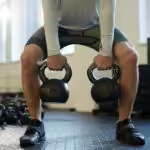

The most effective exercises for calves with dumbbells are the standing calf raise and the seated calf raise, backed up by single-leg raises, donkey raises, step-ups with a calf raise, and farmer’s walks on your toes. Standing moves load the gastrocnemius, the visible upper calf, and seated moves load the soleus underneath it, so a pair of dumbbells and a step cover the whole muscle group.
Key Takeaways
- Do every raise with the balls of your feet on a step or weight plate so your heels can drop below the edge. Raises from a flat floor cut out the stretch that drives calf growth.
- Expect to use less weight seated than standing. The soleus works alone once the knee is bent, so a lighter dumbbell is normal, not a sign of weak calves.
- Pause for one second at the top and take 2 to 3 seconds to lower. Bouncing shifts the load from the muscle to the Achilles tendon.
- Train calves 2 to 3 times a week with 3 to 4 sets of 8 to 15 reps per exercise, and add weight only once every rep of every set is clean.
- Start with single-leg raises if one calf is visibly smaller, since two-handed raises let the stronger side take over.
- If the dumbbells are so heavy that your heels no longer drop below the step, the weight is too heavy for the exercise to work.
What you’ll find here:
- Calf Muscles Worked: Gastrocnemius vs. Soleus
- 1. Standing Dumbbell Calf Raise
- 2. Seated Dumbbell Calf Raise
- 3. Single-Leg Dumbbell Calf Raise
- 4. Dumbbell Step-Ups With Calf Raise
- 5. Dumbbell Donkey Calf Raise
- 6. Dumbbell Farmer’s Walk on Toes
- How to Program Dumbbell Calf Exercises
- Dumbbell Calf Raise Mistakes That Stall Progress
- FAQs
Calf Muscles Worked: Gastrocnemius vs. Soleus
Dumbbell calf exercises work two muscles: the gastrocnemius, the diamond-shaped muscle that gives the calf its visible shape, and the soleus, the flatter muscle that sits underneath it and runs down to the heel. Both attach to the Achilles tendon, and both point your toes downward, which is the movement behind every calf raise.
The gastrocnemius crosses the knee, so it works hardest when your leg is straight. Standing raises, donkey raises, and toe walks are gastrocnemius exercises. Bending the knee slackens the gastrocnemius and hands the work to the soleus, which is why seated calf raises belong in every calf workout. A routine built only on standing raises leaves the soleus undertrained.
1. Standing Dumbbell Calf Raise
The standing calf raise is the foundation of calf training with dumbbells, and it targets the gastrocnemius. The dumbbells add the resistance that bodyweight raises stop providing after the first few weeks.
How to do it:
- Stand with the balls of your feet on a step or weight plate, heels hanging off the edge, feet hip-width apart, and a dumbbell in each hand at your sides.
- Let your heels drop below the step until you feel a stretch in your calves.
- Push through the balls of your feet and rise as high as you can, squeezing your calves at the top for one second.
- Lower for 2 to 3 seconds back to the stretched position. Keep your knees straight but not locked.
Why it works: The straight-knee position puts the gastrocnemius in charge, and the step lets you train it through its full range, from fully stretched to fully shortened. Most people only ever train the top half of that range.
2. Seated Dumbbell Calf Raise
The seated calf raise is the one dumbbell exercise that isolates the soleus, the deeper calf muscle that standing raises leave behind. It replaces the seated calf machine when you train at home.
How to do it:
- Sit on a bench or sturdy chair with your knees bent at 90 degrees and the balls of your feet on a step or plate.
- Rest a dumbbell across each thigh, just above the knee, and steady it with your hands. A folded towel protects the kneecap.
- Drop your heels toward the floor, then press up onto the balls of your feet as high as you can.
- Hold the top for one second and lower under control.
Why it works: With the knee bent, the gastrocnemius cannot contribute much, so the soleus carries the load. Expect to use less weight than you do standing.
3. Single-Leg Dumbbell Calf Raise
The single-leg calf raise fixes side-to-side imbalances because each calf has to lift the load on its own. It also doubles the effective resistance of any dumbbell you own, which matters once your heaviest pair stops feeling heavy on two legs.
How to do it:
- Stand with the ball of one foot on a step, holding a dumbbell in the hand on the same side. Rest your free hand on a wall or rack for balance, not to pull yourself up.
- Hook your free foot behind the working ankle.
- Lower your heel below the step, rise as high as you can, and pause at the top.
- Finish all reps, then switch legs. Start with the weaker leg and match its rep count on the stronger one.
Why it works: Two-handed raises let the stronger calf quietly do more than its share. Working one leg at a time exposes the gap and closes it.
4. Dumbbell Step-Ups With Calf Raise
Step-ups already train the quads and glutes, and adding a calf raise at the top of each step turns them into a full lower-body move with a calf finisher built in.
How to do it:
- Hold a dumbbell in each hand and stand in front of a sturdy step or box at about knee height.
- Step up with your left foot and drive through it until you stand tall on the box.
- At the top, rise onto the ball of your left foot, pause, and lower the heel.
- Step down with control and repeat on the right side.
Why it works: This combo hits your calves, quads, glutes, and core in one movement and raises your heart rate. Treat it as a compound leg exercise with a calf bonus, not as a replacement for the raises above.
If you’re looking for assistance in improving your physical fitness, get in touch with our personal trainers in Fayetteville.
5. Dumbbell Donkey Calf Raise
The donkey calf raise loads the gastrocnemius in its most stretched position, because you hinge at the hips with straight knees. It looks odd, and it is one of the most effective calf exercises you can do with a dumbbell.
How to do it:
- Stand with the balls of your feet on a step, then hinge at your hips and rest your forearms on a bench or rack so your torso is close to parallel with the floor.
- Have a training partner hold a dumbbell on your lower back, just above the hips, or hang one from a dip belt.
- Drop your heels below the step until you feel the stretch behind your knees.
- Rise onto the balls of your feet, hold the top for one second, and lower slowly.
Why it works: The hip hinge pre-stretches the gastrocnemius before every rep, so the muscle works through a longer range than it does in a standing raise. Training a muscle in its lengthened position is one of the strongest growth signals you can give it.
6. Dumbbell Farmer’s Walk on Toes
The farmer’s walk on your toes keeps the calves under constant tension, which builds endurance and ankle stability rather than size. Use it as a finisher after your raises, not as the main event.
How to do it:
- Hold a heavy dumbbell in each hand and stand tall with your shoulders back and your core braced.
- Rise onto the balls of your feet and walk forward with short, controlled steps.
- Keep your heels off the floor for about 30 seconds, or for as long as you can hold your balance.
- Rest, then repeat for 2 to 3 rounds.
Why it works: Your calves never get the rest they get between reps of a raise, and your grip, traps, and core work the whole time. It is the closest thing to a loaded sprint your calves get without leaving the gym floor.
How to Program Dumbbell Calf Exercises: Sets, Reps, and Frequency
Train calves 2 to 3 times a week, with 3 to 4 sets of 8 to 15 reps on each raise, using a weight that leaves one or two reps in reserve at the end of every set. Calves recover faster than most muscles, so they handle frequency well, and they are used to thousands of light steps a day, so they need real load before they respond.
Each session needs one straight-knee exercise for the gastrocnemius and one bent-knee exercise for the soleus. Add a variation or a finisher if you have time. Progress by adding reps until you reach the top of the range, then add weight and drop back to the bottom of the range.
| Exercise | Sets x Reps | Main Muscle |
|---|---|---|
| Standing dumbbell calf raise | 4 x 10 to 12 | Gastrocnemius |
| Seated dumbbell calf raise | 3 x 12 to 15 | Soleus |
| Single-leg dumbbell calf raise | 3 x 8 to 10 per leg | Gastrocnemius |
| Farmer’s walk on toes | 3 x 30 seconds | Both (endurance) |
Swap the single-leg raise for donkey raises or step-ups on your second session of the week so both calf muscles see a different angle each time.
Dumbbell Calf Raise Mistakes That Stall Progress
The four mistakes that stop calves from growing are a short range of motion, bouncing, locked knees, and going too heavy to control the stretch. Each one is easy to fix once you know to look for it.
- Raising from a flat floor. Your heels never drop below neutral, so you lose the stretched half of every rep. Use a step, a plate, or the bottom stair.
- Bouncing out of the bottom. The rebound comes from the Achilles tendon, not the muscle. Pause for a beat at the bottom before you rise.
- Locking the knees. A fully locked knee can cause pain behind the joint. Keep the leg straight with a soft knee on every standing variation.
- Going too heavy. If you cannot pause at the top or drop your heels at the bottom, the dumbbells are too heavy for the exercise to do its job. Drop the weight and earn it back.
FAQs
Is calf muscle hard to grow?
Calves are harder to grow than most muscles for two reasons. They already handle thousands of loaded steps every day, so light work gives them nothing new to adapt to, and the length of the muscle belly versus the tendon is set by genetics. The muscle itself responds to training like any other; it needs a stimulus it is not used to, which is what loaded raises through a full range provide.
How long does it take to strengthen your calves?
Most people feel stronger within 3 to 4 weeks, because the first gains come from your nervous system learning the movement. Visible changes in size take longer, usually 8 to 12 weeks of consistent sessions. If nothing has changed after three months, the fix is almost always more weight or more range of motion, not more exercises.
Does walking strengthen calves?
Walking keeps your calves functional but rarely makes them stronger, because the soleus handles each step at a small fraction of its capacity. Walking uphill or with a weighted backpack adds some challenge. For measurable strength and size, calves need resistance they are not used to, which is the whole point of adding dumbbells.
Final Thoughts: Exercises for Calves With Dumbbells
A pair of dumbbells and a step are enough to train both calf muscles through their full range, which is more than most gym machines manage. Pick one standing move and one seated move, train them 2 or 3 times a week, and add weight when the reps get easy. If you would rather have a coach set your starting loads and check your form, that is what our trainers do every day.