
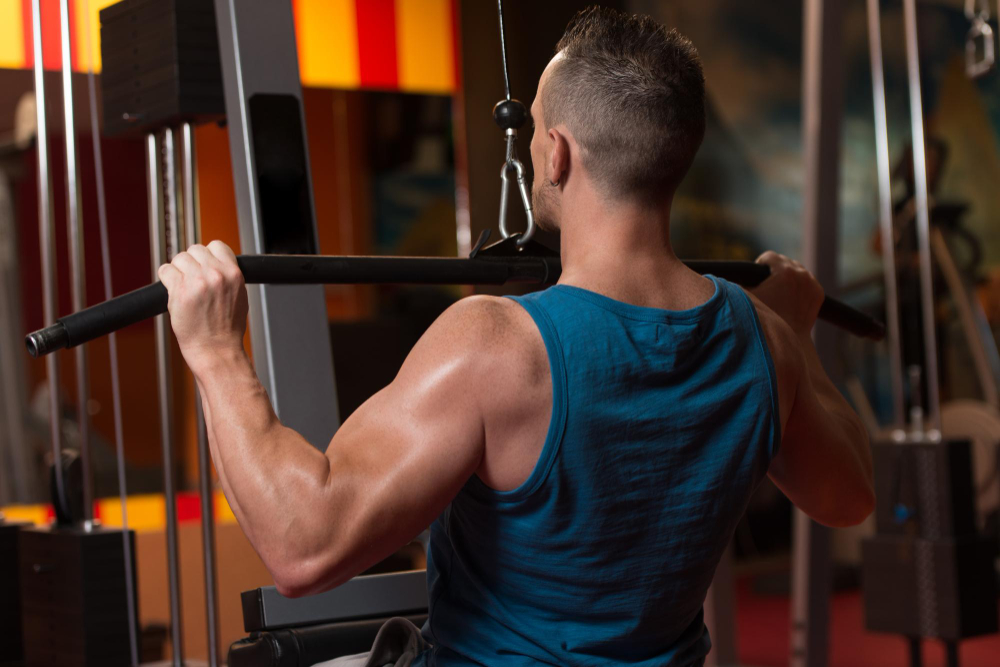
This 30-minute back and bicep workout will be more than enough if you are a beginner or intermediate lifter. Follow our step-by-step instruction video for a workout overview and proper form tips.
Key Takeaways
- 30 minutes can be enough for an effective back and bicep workout if you use proper exercise selection and short rest periods.
- Training back and biceps together is efficient because most back exercises already activate the biceps during pulling movements.
- Short rest periods can increase fatigue and reduce strength output.
- To engage your back more than your biceps, focus on driving your elbows, slowing down eccentric reps, pausing at peak contraction, and avoiding excessive grip tension.
30-Minute Back and Bicep Workout
This quick but effective back and bicep workout is more than enough to target all the major muscles. You will train the lower back, upper back, lats, and biceps through pulling movements and additional isolation exercises.
Warm Up
| Exercise | Time | Instructions |
| Arm circles | 1 minute, 30 seconds forward, 30 seconds backward | Stand with feet shoulder-width apart. Keep arms straight at shoulder height and make controlled circles forward, then backward. |
| Arm circles with PVC pipe | 1 minute, 30 seconds forward, 30 seconds backward | Hold the pipe with a wide grip. Keep your core tight and posture stable. Rotate within a comfortable range of motion without shrugging your shoulders. |
| Bodyweight row, TRX suspension | 2 sets of 10 reps | Grip the handles tightly and keep your body in a straight line. Row until your elbows reach your sides, then slowly return to the starting position while keeping your shoulders down and back. |
Always start with a warm-up. Not only can a 5-minute warm-up help you perform better, but it also reduces the chances of injury, especially with this type of workout when you have less time between sets.
Another important thing, even if you are short on time, don’t rush through reps. Controlled motion in both directions is always going to win over quick reps. It’s better to cut one exercise completely than to rush if time is your concern.
List of Exercises
| Exercise | Number of Sets / Reps | Rest | Instructions |
| Pull Ups / Assisted Pull Ups | 2 sets of 8-10 reps, 3 sets of 8-10 reps for assisted variation | 1 minute rest between sets | Use a shoulder-width grip. Keep your core tight, pull elbows toward your ribs, then lower slowly. |
| Barbell Bent Over Rows | 3 sets of 10-12 reps | 1 minute rest between sets | Keep your back flat. Row the bar toward your belly button, squeeze shoulder blades, then lower slowly. |
| Dumbbell Single Arm Row | 3 sets of 12 reps each arm | 1 minute rest between sets | Support yourself on a bench. Pull the dumbbell toward your hip, squeeze at the top, then lower slowly. |
| Face Pull | 3 sets of 15 reps | 45-second rest between sets | Pull the rope toward your face with elbows out. Squeeze shoulder blades, then return slowly. |
| Dumbbell Bicep Curl / Alternating Bicep Curl with Static Hold | 3 sets of 12-15 reps | 45-second rest between sets | Keep elbows close to your body. Curl with control, squeeze at the top, then lower slowly. |
| Hammer Curl with Rope Attachment | 2 sets of 12-15 reps | 45-second rest between sets | Keep palms facing each other and use slow, controlled reps. |
Cool Down
| Exercise | Time | Instructions |
| Overhead tricep stretch | Hold for 20-30 seconds each side | Raise one arm overhead and gently press the elbow back until you feel a stretch. |
| Cross-body shoulder stretch | Hold for 20-30 seconds each side | Pull one arm across your chest and keep your shoulders relaxed. |
| Child’s pose | Hold for 30-60 seconds | Sit hips back toward your heels and stretch your arms forward on the floor. |
Is 30 Minutes Enough for a Back and Bicep Workout?
Yes, 30 minutes can be enough for a back and bicep workout, especially if you follow the structure we shared that targets all the major muscles.
The goal is to do enough sets per muscle group, which you will achieve with this workout. But what counts as enough sets? According to Jeff Nippard, one of the most well-known science-based lifters in the fitness industry, this can be enough training volume for both beginners and intermediate lifters.
- Beginners (less than 1 year of active lifting): 1 to 5 sets per muscle group
- Intermediate (1 to 4 years of lifting): 4 to 8 sets per muscle group
In this workout, you will complete:
| Muscle Group | Sets |
| Lats | 8 |
| Upper Back | 11 |
| Lower Back | 3 |
| Biceps | 11 |
| Rear delts | 9 |
Downsides of a 30-Minute Workout
This type of workout comes with limitations, even if you match, or in some cases exceed, the recommended number of sets. The main downside is the short rest periods between exercises.
Here is why this may affect your workout:
- Less strength output: Short rest periods can reduce how much weight you lift, especially during compound exercises like pull ups and rows.
- Higher fatigue: Your muscles and cardiovascular system recover less between sets, which can make later exercises feel harder.
- Reduced performance: As fatigue builds, your form and rep quality may start to decline.
Exercise Alternatives
If for any reason, you don’t like to perform certain exercises from our workout, or you want something more challenging, you can switch them up with these:
Pull-up / Assisted Pull-Up
- Easier: Lat Pulldown
- Harder: Weighted Pull-Up
Barbell Bent Over Rows
- Easier: Chest-Supported Machine Row
- Similar: T-Bar Row
Dumbbell Single Arm Row
- Easier: Machine Iso-Lateral Row
- Similar: Meadows Rows
Face Pull
- Easier: Reverse Pec Deck
- Similar: Rear Delt Cable Fly
Biceps Curl
- Easier: Cable Bicep Curl
- Harder: Strict Wall Curls
Hammer Curl
- Similar: Dumbbell Hammer Curl
- Similar: Crossbody Hammer Curl
Is It Good to Train Back and Biceps Together?
Yes, training back and biceps together is one of the most popular workout splits, and for good reason. Most back exercises are pulling movements, which naturally involve the biceps.
Because of that, your biceps are already warmed up and activated, so you can move into curls and isolation work more efficiently.
Older bodybuilding programs sometimes paired back with triceps instead. The idea behind this approach was to avoid pre-fatiguing the biceps during back training. In the end, you should choose which approach is best for you based on how you feel during the workout.
Modern weight-lifting programs prefer back and biceps in the same workout. Here are the pros and cons of the method:
Pros:
- Both muscle groups work during pulling movements, so the workout flows naturally.
- Your biceps are already activated from rows and pull ups before isolation exercises begin.
- Many people enjoy the overall arm and upper back pump that comes from combining these exercises.
Cons:
- Your biceps may already be tired before curls and isolation work start.
- Fatigue from heavy rows or pull ups can affect your strength during later exercises.
- Longer pulling sessions can make grip strength a limiting factor, especially for beginners.
How to Engage Back More Than Biceps?
One of the most common problems during back training is pulling too much with the biceps instead of the back muscles.
This usually happens because the arms naturally want to take over during pulling exercises, especially when the weight is heavy.
Here are a few tips that can help you engage your back muscles more during training:
- Drive your elbows, not your hands: Focus on pulling your elbows backward or downward instead of thinking about moving the weight with your hands. This helps shift tension onto the back muscles.
- Slow down the eccentric: Control the lowering phase of each rep instead of letting the weight drop quickly. This keeps more tension on the back and improves muscle control.
- Pause at peak contraction: Hold the top position for one to two seconds and squeeze your shoulder blades together before lowering the weight.
- Avoid excessive forearm dominance: Don’t grip the handle harder than necessary, or the forearms and biceps will take over the movement.
FAQ
How often should you train back and biceps?
Most people will see good results training back and biceps 1 to 2 times per week. But if you follow this exact program with the exact number of reps, once a week will be enough.
Should I use straps?
You can use straps if your grip strength fails before your back muscles. They are especially useful exercises with heavier weights where grip fatigue becomes a limiting factor. But keep in mind also that this type of workout also trains your forearms. If you use straps, the progress for that muscle group will slow down.
Is this workout good for building muscle?
Yes, this workout includes enough volume, compound lifts, and isolation exercises to support muscle growth, especially for beginners and intermediate lifters. Progressive overload and proper nutrition will also play a major role in your results.
Can I do dumbbell rows instead of barbell rows?
Yes, dumbbell rows are a great alternative. They may feel more comfortable and easier for some people. So if you don’t prefer heavier weights and barbells, then you can go with this alternative.
Why do my forearms get tired before my back?
This usually happens because your grip and forearms fatigue before your back muscles do. Using too much weight, overgripping the handles, or relying too much on the arms during pulling exercises can make this problem worse.