This 30-minute leg workout at the gym is built for anyone who wants an efficient lower-body routine. It combines effective exercises, rest periods, and a simple structure that is easy to follow.
Key Takeaways
- A proper warm-up can improve performance and reduce the risk of gym injuries.
- Shorter rest periods make 30-minute workouts efficient for hypertrophy and overall muscle building, but not for strength or maximum weight lifting.
- Progressive overload is important for muscle growth, whether through adding weight or increasing reps.
- Exercise alternatives can help if a movement feels uncomfortable, causes pain, or does not match your fitness level or mobility.
- Leg days feel difficult because lower-body exercises require a lot of energy and place high stress on large muscle groups.
30-Minute Leg Workout at the Gym
With the exercises in this workout, you will target all parts of the lower body. Nothing gets left out, and you will build a well-rounded physique. The workout can be done in 30 minutes, so it’s ideal if you are looking for a routine that is fast and effective.
Warm Up
| Exercise | Time | Instructions |
| Leg swings | 2.5 minutes | Hold onto a wall or rack for balance, then swing one leg forward and backward. |
| High knees and butt kicks | 2.5 minutes | Alternate between high knees and butt kicks for 30 seconds each to raise your heart rate and loosen your legs before training. |
Warm-ups are important because they increase blood flow, improve mobility, and help reduce the risk of strains and other common gym injuries. Research also shows that warming up improved performance in 79% of the performance measures examined.
Leg swings, high knees, and butt kicks are great choices because they activate the lower body but don’t add fatigue before your main lifts. These movements loosen the hips, warm up the knees and ankles, and help your body move more efficiently.
List of Exercises
| Exercise | Number of sets / Reps | Rest | Instructions |
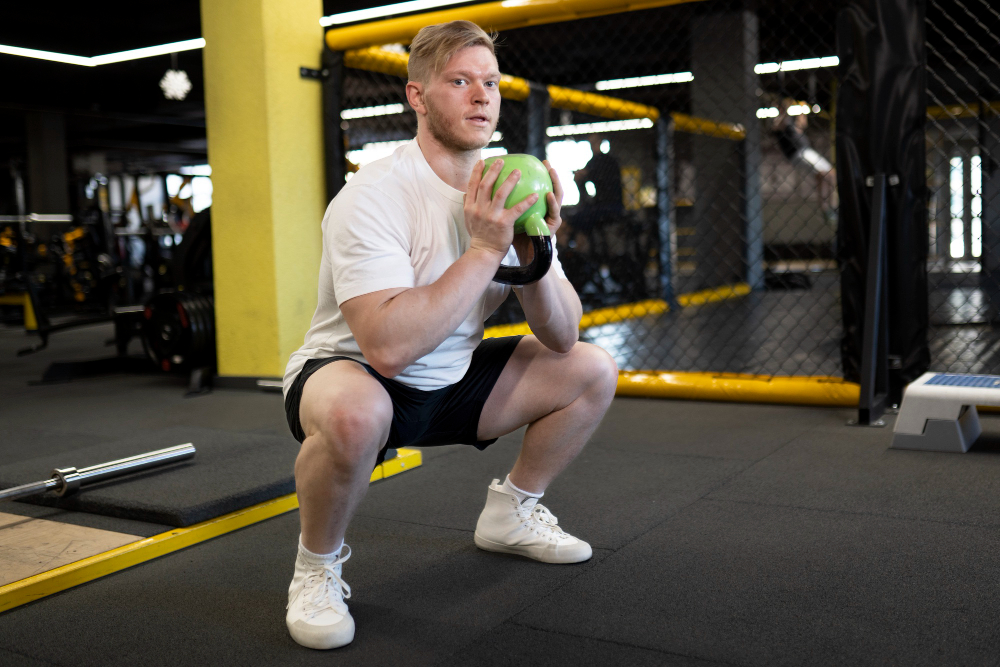
| Goblet Squat | 3×12-15 | 1 minute rest between sets | Hold the weight close, elbows tucked. Sit back, knees out, and chest up. Drive through your heels, squeeze glutes at the top. |
| Forward Lunge | 3×12-15 | 1 minute rest between sets | Step forward, keep your chest up. Lower straight down, front knee over ankle. Push back through your heels, return to the start. |
| Leg Press | 3×10-12 | 1 minute rest between sets | Feet shoulder-width, knees in line with toes. Lower slowly, keep your back pressed into the seat. Drive through the heels, don’t lock your knees. |
| Romanian Deadlift | 3×12 | 1 minute rest between sets | High at your hips, soft knees. Keep your back flat, chest up. Drive through your heels, squeeze glutes at the top. |
| Machine Leg Curls | 3×12-15 | 1 minute rest between sets | Press your hips down, keep your core tight. Curl your heels toward your glutes, and squeeze. Lower slowly, feel the stretch. |
| Calf Raises | 4×15-20 | 30-second rest between sets | Stand tall, weight on the balls of your feet. Lift up, squeeze at the top. Lower slowly, control the descent. |
Cool Down
| Exercise | Time | Instructions |
| Kneeling lunge (hip flexor stretch) | Hold for 20-30 seconds | Step into a kneeling lunge position with one knee on the floor, then gently push your hips forward until you feel a stretch through the hip flexors. |
| Standing quad stretch | Hold for 20-30 seconds | Stand tall, grab one ankle behind you, and pull it toward your glutes while keeping your knees close together. |
Exercise Alternatives You Can Try
If you don’t like some of these exercises, or you find some too easy or too difficult, you can replace them with one of these alternatives.
Goblet Squat
- Box Squat (Easier)
- Dumbbell Front Squat (Similar)
- Barbell Front Squat (Harder)
Forward Lunge
- Reverse Lunge (Easier)
- Walking Lunge (Similar)
- Bulgarian Split Squat (Harder)
Leg Press
- Wall Sit (Easier)
- Hack Squat (Similar)
- Barbell Back Squat (Harder)
Romanian Deadlift
- Glute Bridge (Easier)
- Stiff-Leg Deadlift (Harder)
Machine Leg Curls
- Cable Leg Curl (Similar)
- Nordic Hamstring Curl (Harder)
Calf Raises
- Single-Leg Calf Raise (Similar)
- Donkey Calf Raise (Harder)
When to Try These Alternatives?
There is no single exercise that everybody must do. The best workout is the one you can perform safely, consistently, and with good effort.
You may want to switch exercises if:
- You don’t like performing a certain exercise
- You feel unusual or sharp pain during a movement
- You don’t feel the target muscles working properly
- You have limited mobility that affects your form
- Gym equipment is unavailable or too crowded
- You want more variety in your routine
Training should feel challenging, but you should not dread every session. If you actually enjoy your workouts, it becomes much easier to stay consistent and keep making progress over time.
For a dumbbell-only set of exercises, try our 6-workout hamstring plan.
Is 30 Minutes Enough for a Leg Workout?
Yes, 30 minutes can be enough for an effective leg workout, especially if you follow a structured program and stay consistent with it.
Shorter workouts usually mean shorter rest periods between sets, which can slightly reduce recovery during the session. Even so, this approach still works well for hypertrophy and overall muscle building.
That said, a 30-minute workout is not the best option if your main goal is building maximum strength or lifting as heavy as possible. Heavy strength-focused training often requires longer rest periods to fully recover between sets. But for muscle growth, conditioning, and maintaining a consistent routine, these types of shorter leg workouts can still be very effective.
For active recovery after leg day, read our full breakdown that takes into account the existence and/or the level of soreness.
Progressive Overload Guide
You should always aim to do slightly better than in your previous workout. This gradual increase in training demand is important for challenging your muscles and stimulating hypertrophy over time.
One of the simplest ways to progress is by increasing the weight gradually. Even adding 5 pounds can make a meaningful difference when done consistently over several weeks or months. Small improvements add up faster than most people realize.
You can also progress by increasing the number of reps you perform. For example, if your target is 12 reps but you can only complete 10 with good form, try reaching 11 or 12 during your next workout. Once you consistently hit the top of the recommended rep range, usually 12 to 15 reps depending on the exercise, it’s time to increase the weight.
That’s why tracking your workouts is another important part of progression. Whether you use a notebook, an app, or an organized spreadsheet, keeping records helps you spot improvements.
Why Are Leg Days Hard?
Leg days feel especially difficult because exercises like squats and leg presses require a lot of energy, oxygen, and overall effort, which is why you often feel exhausted after a hard workout.
Muscle soreness is also common after leg training because these exercises place a high amount of stress on the muscles, especially during slow lowering movements and higher training volumes.
To reduce soreness and recover better, here are a few things that can help:
- Warm up properly before training
- Avoid skipping leg day for long periods
- Add light walking or stretching after training
- Eat enough protein and overall calories
FAQ
How often should you do this 30-minute leg workout?
Once a week is enough. In most cases, a workout program includes one leg day per week. Since leg workouts usually require longer recovery, most people don’t train legs two or three times weekly.
Can I do this workout as a beginner?
Yes, beginners can absolutely do this workout as long as they focus on learning proper form first. Make sure to watch our video instructions, practice with a lighter weight, and if possible, record yourself or use a mirror to check your technique.
Can I do cardio after this workout?
You should usually skip cardio after a hard leg workout. Your legs are going to feel sore and exhausted afterward, and most cardio exercises require additional leg engagement, which can make recovery more difficult.
What weights should I use?
A starting point is a weight that lets you complete most of the target reps with effort, while still keeping good form from start to finish. For example, if the goal is 12 reps, the last few reps should feel difficult, but not sloppy or unsafe. If the weight feels too easy, increase it slightly during your next set.