Written by Kaashif Ameer, Strength and Conditioning Coach at HiTONE Fitness, former Marine, and EAS Body for Life champion.
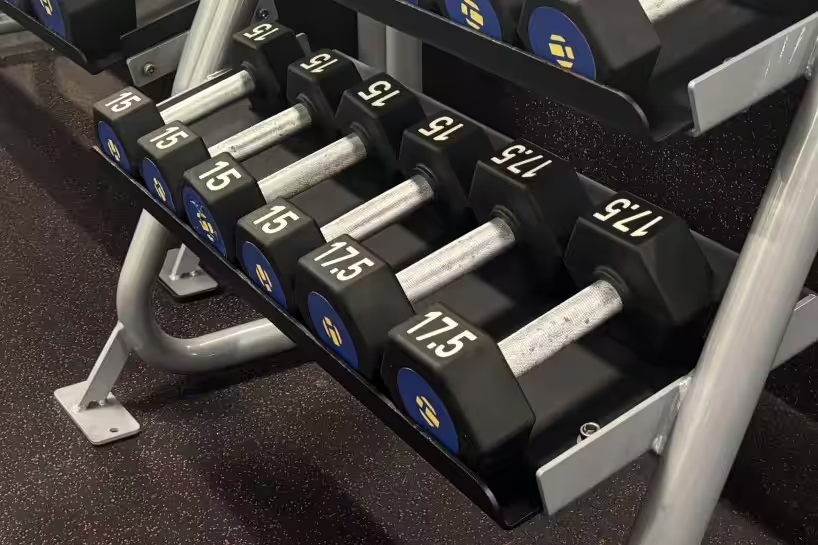
The five best dumbbell forearm exercises are the wrist curl, reverse wrist curl, hammer curl, Zottman curl, and farmer’s walk. Run as a short finisher once or twice a week and loaded a little heavier over time, they train every job the forearm does, wrist flexion, wrist extension, and grip, and build real size and strength with nothing but a pair of dumbbells.
Key Takeaways
- Most forearm size comes from heavy pulling. If your deadlifts, rows, and pull-ups are heavy, dedicated forearm work is a supplement, not the main driver.
- Keep forearm work off your heavy pulling days. That training already taxes your grip, so pair forearm sets with push or leg days instead.
- The brachioradialis responds to curls, not wrist curls. Hammer, reverse, and Zottman curls build the muscle that adds visible forearm thickness.
- For more range on wrist curls, let the dumbbell roll to your fingertips, then curl back up. The deeper stretch trains the flexors harder.
- Expect visible change in about 8 to 12 weeks of consistent, progressive work. Grip and strength improve well before size does.
- Light and controlled beats heavy and sloppy. Wrist curls are a small movement, and ego weight just shifts the work to your arms.
Can You Build Forearms With Just Dumbbells?
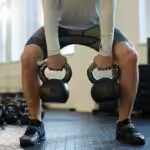
Yes. A single pair of dumbbells trains every forearm muscle through a full range of motion, which is all you need for size and grip. Kettlebells work just as well, and none of these moves need a machine, a cable, or anything you don’t already have at home or in the gym.
The Forearm Muscles You Are Training
The forearm is a group of muscles that control your wrist, fingers, and grip, and they work in almost every upper-body lift.
- Wrist flexors: Along the inside of the forearm. They bend the wrist and close your grip.
- Wrist extensors: On the top of the forearm. They straighten the wrist and stabilize it under load.
- Brachioradialis: On the outer forearm near the elbow. It adds visible thickness and helps flex the elbow.
Benefits of Stronger Forearms
Stronger forearms remove a weak link from your pulling and carry over well beyond the gym. Key benefits include:
- Better grip strength: A stronger grip improves deadlifts, rows, pull-ups, and carries. When your grip stops failing first, the target muscles can finish the set.
- Thicker-looking arms: Developed forearms make your arms look fuller and more balanced, even at rest.
- Healthier wrists and elbows: Strong forearm muscles stabilize the joints, which can reduce strain and the risk of overuse pain.
- Stronger pulling: Rows, chin-ups, and lat pulldowns feel more controlled when your forearms are not the limiting factor.
Grip strength also tracks with overall health. A 2015 Lancet study of nearly 140,000 adults found grip strength predicted death more strongly than systolic blood pressure.
When to Train Your Forearms
Train forearms as a finisher, once or twice a week, at the end of a session. Keep them off your heavy pulling days: deadlifts, rows, and pull-ups already fatigue your grip, so stacking forearm work on top blunts both. For general size and a stronger grip, that is enough. If you train for grip sports, climbing, combat sports, or a bigger deadlift, add frequency and volume from there.
The 5 Best Dumbbell Forearm Exercises
These five moves cover every function of the forearm. Work through them with control, and load them a little heavier as they get easier.
1. Dumbbell Wrist Curl (Palms-Up)
The wrist curl trains the flexors on the inside of your forearm, the muscles that close your grip and are often underdeveloped. It builds the largest share of forearm mass, which is why it leads the list.
- Sit on a bench with your forearms resting on your thighs, a dumbbell in each hand, palms facing up.
- Let your wrists hang off the edge of your thighs.
- Curl the dumbbells up by flexing your wrists, keeping your forearms flat against your legs.
- Hold for a second at the top, then lower under control.
Tip: At the bottom, let the dumbbell roll into your fingertips, then curl it back up. That extra range trains the flexors under a deeper stretch. Keep the weight moderate; the goal is control, not load.
2. Dumbbell Reverse Wrist Curl (Palms-Down)
The reverse wrist curl trains the extensors on the top of your forearm. They are smaller and weaker than the flexors, but more visible when your arms hang at your sides, so they matter for balanced, aesthetic forearms.
- Sit with your forearms on your thighs, this time holding the dumbbells palms down.
- Let your wrists hang off the edge of your thighs.
- Extend your wrists upward, lifting the dumbbells with your forearm muscles.
- Pause at the top, then lower to the start.
Tip: This one is harder than the palms-up version, so drop the weight. Keep your elbows tucked so the work stays in your forearms and not your upper arms.
3. Dumbbell Hammer Curl
The hammer curl trains the brachioradialis, the muscle that adds visible forearm thickness, and its neutral grip lets you handle more weight than most forearm moves. A 2023 study in Sports found the grip you use changes how much of a curl’s load lands on the brachioradialis.
- Stand tall with a dumbbell in each hand, arms at your sides, palms facing each other.
- Curl the dumbbells toward your shoulders without rotating your wrists.
- Lower them under control to the start.
Tip: Keep your elbows pinned to your sides and do not lean back as you lift. Squeeze the handles hard; the tighter your grip, the more your forearms work.
4. Zottman Curl
The Zottman curl works the flexors on the way up and the extensors on the way down, hitting both sides of the forearm in one rep. It rolls a curl and a reverse wrist curl into a single efficient movement.
- Stand with a dumbbell in each hand, palms facing up.
- Curl the dumbbells to shoulder height as you would a normal curl.
- At the top, rotate your wrists so your palms face down.
- Lower slowly in this position, working the extensors on the descent.
Tip: The slow, palms-down lowering is where the forearm work happens, so do not rush it. The rotation trains both the flexor and extensor muscles and builds wrist control for grip-heavy lifts.
5. Farmer’s Walk
The farmer’s walk builds grip strength and forearm endurance by making you hold heavy dumbbells over distance. It trains your core and posture at the same time, and it carries over directly to real-world lifting and carrying.
- Stand with a heavy dumbbell in each hand, arms extended, gripping the weights firmly.
- Walk a set distance with a tall posture, shoulders back and core braced.
- Keep a steady pace and do not let the dumbbells swing or your shoulders round forward.
Tip: Start with a manageable weight over 20 to 30 meters, then build distance as your grip improves. The longer you hold, the more your grip develops.
A Simple Dumbbell Forearm Workout
Add one of these two short workouts to the end of a training day, alternating A and B through the week. Finish each set one or two reps short of failure, and add weight or reps once you hit the top of the range.
Workout A
- Dumbbell Wrist Curl: 2 sets of 12 to 15 reps
- Reverse Wrist Curl: 2 sets of 12 to 15 reps
- Hammer Curl: 3 sets of 8 to 12 reps
Workout B
- Zottman Curl: 3 sets of 8 to 12 reps
- Farmer’s Walk: 3 rounds of 30 to 40 meters
Two sets of two or three moves is enough. You are already getting forearm work from your heavy pulling, so these sessions only need to cover what that misses.
Bodyweight Grip Add-Ons
No heavy dumbbells for farmer’s walks? Two bodyweight holds still challenge your grip:
- Dead hangs: Hang from a pull-up bar with your shoulders active, holding as long as you can.
- Towel hangs: Loop a towel over the bar and grip that. The thicker, unstable hold makes your forearms work harder.
FAQs
Is three exercises enough for forearms?
Yes, as long as the three cover the forearm’s main jobs: wrist flexion, wrist extension, and grip or brachioradialis work. A wrist curl, a reverse wrist curl, and a hammer curl or farmer’s walk hit all of them. More exercises add variety, not necessarily better results.
Do regular dumbbell curls work your forearms?
Yes, to a point. Any curl makes your grip and brachioradialis work to control the weight, so standard and hammer curls do build the forearms. For the most direct growth, pair them with wrist curls that train the flexors through a full range.
How long does it take to see forearm gains?
With consistent, progressive training, expect noticeable grip and strength gains within a few weeks and visible size in about 8 to 12 weeks. Forearms are dense and used all day, so they often respond slower than showier muscles. Progressive overload is what keeps the change coming.
What single exercise works forearms the most?
No single move covers everything, but the wrist curl trains the largest share of forearm muscle, and the farmer’s walk builds grip and endurance hardest. Rotating both, plus a hammer or Zottman curl for the brachioradialis, beats leaning on one exercise.
Final Thoughts: Dumbbell Forearm Exercises
You do not need special gear to build your forearms. Five dumbbell moves, trained as a finisher and loaded a little heavier over time, cover every function of the muscle. If you want a coach to check your form or fold these into a full program, personal training at HiTONE can help. For the rest of your arm work, pair this with our dumbbell chest workout and dumbbell tricep exercises.