

When it comes to push-ups vs bench press, both exercises are often placed in competition with each other. At a glance, they train the same primary muscles: the chest, shoulders, and triceps. That’s why they’re frequently compared and why the debate keeps coming up.
The bench press usually feels more effective. But in the right context, push-ups can be more than enough to build strength and muscle.
Key Takeaways
- Push-ups and bench press train the same main muscles
- The movement pattern is similar, but the demands are different
- Push-ups require full-body tension and core stability
- Bench press removes stability and emphasizes load
- Bench press builds maximal pushing strength more efficiently
- Push-ups have a strength ceiling
- Advanced lifters benefit more from bench press for growth
What Push-Ups and Bench Press Have in Common
In both exercises, you are pushing the weight away from your body in a straight line. With push-ups, that weight is your body. With the bench press, it’s a barbell or dumbbells.
They also train the same main muscles. Your chest does most of the work, while the shoulders and triceps help finish each rep. And yes, both can build muscle and strength. If the exercise is challenging, done with good form, and progresses over time, your body will adapt. Muscle does not care whether resistance comes from your bodyweight or a bar.
Push Ups vs Bench Press – The Key Difference
| Push Ups | Bench Press |
| You move your body through space | You move the weight through space |
| Your hands stay fixed on the floor | The bar or dumbbells move freely |
| Your core and hips must stay tight to keep your body straight | Your body is supported by the bench |
| Stability is part of the challenge | Load is the main challenge |
With push ups, your entire body has to work together. If your core or hips relax, the rep breaks down immediately.
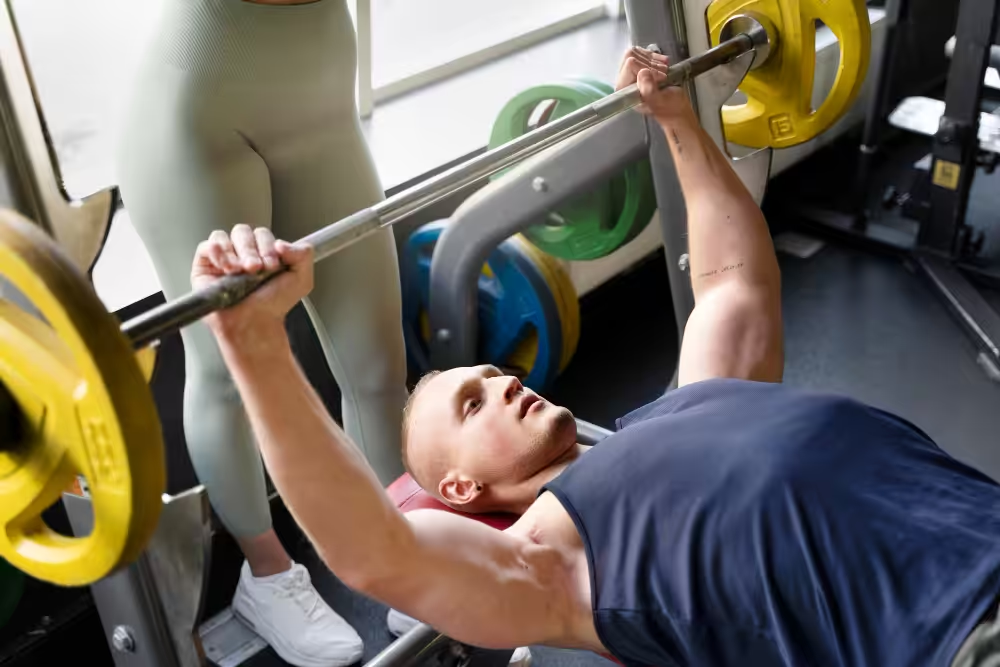
With the bench press, your body is supported, so most of the effort goes into pressing the load. This allows you to focus on moving heavier weights and progressing strength more directly.
Muscle Activation and Training Effect
Push-ups and bench press work the same muscles, but they ask your body to do different jobs. That’s why they feel so different in practice.
Push-ups emphasize:
- Core and shoulder stability: Your abs, lower back, and hips have to stay tight the entire time. If your core relaxes, the rep falls apart.
- Total body tension: Push-ups are not just an upper-body move. Your legs are tight, your glutes are engaged, and your upper back stays active to keep everything connected.
- Muscular endurance: Push-ups are usually done for higher reps, which builds the ability to stay strong while tired. This carries over well to sports and everyday movement.
Bench press emphasizes:
- Chest loading: Because your body is supported by the bench, the chest takes on more of the work with less need to stabilize.
- Triceps strength: As the weight increases, the triceps work harder, especially at the top of the rep. This is key for pressing strength.
- Upper body force production: Bench press allows heavy loading and clear progression, making it ideal for building raw pushing strength.
Muscle Growth – Push Ups vs Bench Press
How well each works depends on your training level, available equipment, and how much resistance you can apply over time.
Push-ups can be more than enough to build muscle in many situations.
- Beginners: For someone new to training, push-ups provide plenty of resistance. The chest, shoulders, and triceps respond quickly to consistent bodyweight training.
- High-rep training: Push-ups work well in moderate to high rep ranges, where muscle growth comes from fatigue and time under tension rather than heavy weight.
- Limited equipment setups: If you train at home or while traveling, push-ups allow you to train the chest effectively without needing a bench or weights.
- Bodyweight or lightly loaded hypertrophy: Variations like slow reps, pauses, feet-elevated push-ups, or light external loading can continue to stimulate muscle growth for a long time.

Bench press becomes the better option when muscle growth depends on heavier and more progressive loading.
- Progressive overload: You can easily add small amounts of weight over time, which keeps the muscle adapting.
- Heavier loading: Bench press allows far more resistance than push-ups, creating stronger mechanical tension on the chest and triceps.
- Long-term hypertrophy: As your body adapts, muscle growth requires more stimulus. Bench press makes it easier to keep that stimulus high.
- Advanced lifters: Once push-ups no longer feel challenging, the bench press becomes a more efficient tool for continued muscle growth.
Read Next: Dips vs Bench Press: Why One Should Always Come First

Which One Is Better for Strength?
Push-ups are great for building a base, but they have strength limits. You can only work with your bodyweight, and once that stops feeling challenging, progress slows down. You can add difficulty with tempo, pauses, or light weight, but those options only take you so far. There is a ceiling you eventually hit.
Bench press is better for max strength because it makes progression simple and measurable. You can add weight in small steps and track exactly how strong you are getting. Lifting heavier loads allows your body to produce more force, which is what real strength is built on.
Read Next: Bench Dips vs. Parallel Bar Dips
Best Ways to Make Push-Ups More Challenging
At some point, regular push-ups stop feeling hard. Here are the most effective ways to make them more challenging.
Progressions You Can Do Without Equipment
Small changes in how you perform each rep can dramatically increase the challenge.
- Slow down the reps: Lower yourself for 3 to 5 seconds and press up with control. Slower reps increase time under tension and make the muscles work harder.
- Add pauses: Pause for one or two seconds at the bottom of each rep. This removes momentum and forces the chest and triceps to produce more force.
- Increase total volume: Adding more reps, more sets, or reducing rest time can continue driving progress when load options are limited.
Harder Push-Up Variations
Changing the variation is one of the simplest ways to increase difficulty.
- Feet-elevated push-ups to shift more load onto the upper chest and shoulders
- Close-grip push-ups to increase triceps demand
- Wide-grip push-ups to emphasize the chest
- Single-arm or staggered push-ups to increase unilateral load
- Deficit push-ups using handles or blocks to increase the range of motion
Using Equipment to Increase Resistance
If you want to keep progressing, adding resistance is the most effective option.
- Weighted vest: This is the cleanest way to load push ups. The weight stays centered and allows consistent progression.
- External load: A backpack with books, weight plates, or sandbags can work. The key is keeping the load secure so it does not shift during the set.
- Resistance bands: Loop a band across your upper back and anchor it under your hands. This increases resistance as you press up, making the top of the rep more challenging without overloading the shoulders at the bottom.

FAQ
Do push-ups build the upper chest the same way the bench press does?
Not exactly. Standard push-ups mostly target the mid and lower portion of the chest. You can shift more work toward the upper chest with feet-elevated push-ups, but they still don’t load the upper chest as directly as an incline bench press.
Can push-ups replace the bench press if I don’t have gym access?
Yes, they can. If you don’t have access to a gym, push-ups are a solid replacement. They may not develop maximal strength the same way the bench press does, but they will keep you strong and fit.
How often should I train with push-ups or bench press each week?
At the beginning, push-ups can be trained up to three times per week because they because hey’re easier to recover from. Bench press and dedicated chest workouts are better limited to once per week.
Is it better to do push-ups every day or add rest days?
Adding rest days is usually better. Push-ups are less taxing than the bench press, but muscles still need time to recover and grow. Daily push-ups can work for light volume or technique practice, but for muscle and strength gains, rest days help you progress faster and stay injury-free.
Can push-ups help improve bench press strength?
Push-ups could build pressing endurance, shoulder stability, and core strength, all of which support bench press performance.