
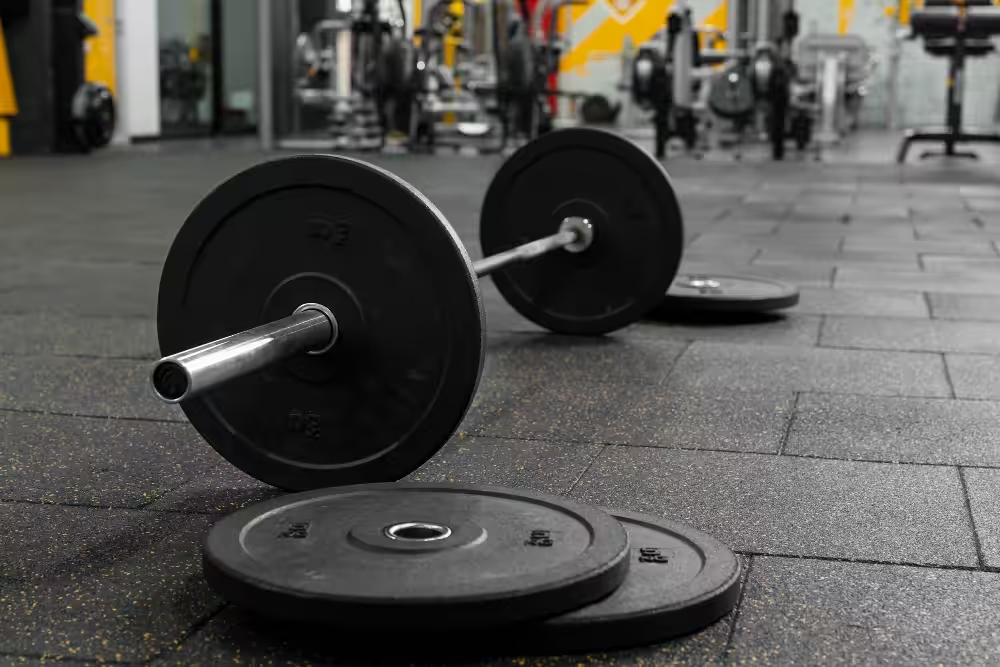
Many people use the terms free weights and dumbbells interchangeably. That’s where the confusion starts. Dumbbells are basically free weights. But if the question is if the preferred weight is going to affect strength, muscle growth, safety, and long-term progress, then you need to read this breakdown.
Key Takeaways
- Dumbbells expose imbalances and demand more control and stabilization
- Barbells are more stable and allow much heavier loading
- Dumbbells allow a more natural range of motion and often feel easier on joints
- Muscle growth is possible with both tools, but through different stress patterns
- Dumbbells favor control, symmetry, and clean execution
- Barbells favor progressive overload and maximal strength development
- Heavy compound lifts are best performed with barbells
Free Weights vs Dumbbells – The Key Comparison
The biggest difference between dumbbells and barbells comes down to how the load is applied and controlled.
Bilateral vs unilateral loading
- Barbells distribute one load across both sides of the body at the same time.
- Dumbbells load each side independently.
This matters because with a barbell, your stronger side can help your weaker side without you noticing. Dumbbells remove that safety net and force each side to do its own work.
Stability requirements
- Barbells are more stable because both hands are connected to one object.
- Dumbbells demand more control since each hand moves independently.
That extra instability is not a flaw. It simply shifts more work onto stabilizing muscles and coordination.
Load potential
- Barbells allow significantly heavier weights.
- Dumbbells are usually limited by grip strength, balance, and available increments.
If your goal is maximal strength or long-term load progression, barbells have a clear advantage. If control and symmetry matter more, dumbbells work better.
Range of Motion Differences
Range of motion plays a major role in how an exercise feels and how effectively muscles are loaded.
Dumbbells allow more natural movement because each arm moves on its own path. Your wrists and shoulders can rotate freely, which lets the joints settle into positions that feel natural. For people with shoulder or elbow discomfort, or anyone whose anatomy does not fit perfectly into fixed positions, dumbbells tend to feel smoother and more forgiving.
With barbells, both hands are locked into a fixed position so the range of motion can be limited. However, that same fixed setup helps standardize depth and bar path in lifts such as squats and deadlifts. In these cases, consistency matters more than freedom. Barbells reduce variability, which makes them easier to load heavily and progress over time.
Muscle Activation and Stabilization
With dumbbells, there is no shared load and no opportunity for one side to compensate for the other. This makes dumbbells especially effective for revealing strength imbalances and improving symmetry over time.
Barbells favor overall force production and efficiency, especially when lifting heavier weights.
Dumbbells, on the other hand, increase stabilizer involvement. Exercises like presses, rows, and lunges demand more control through the shoulders, core, and hips. Barbells rely more on full-body tension and bracing, particularly under heavy loads.
Which Is Better for Building Muscle?
Both dumbbells and barbells can build muscle effectively, but they do so through slightly different mechanisms. The better choice depends on:
- How do you want to create tension
- How much load can you handle
- How evenly does your body develop under stress
When Dumbbells Are Better for Hypertrophy
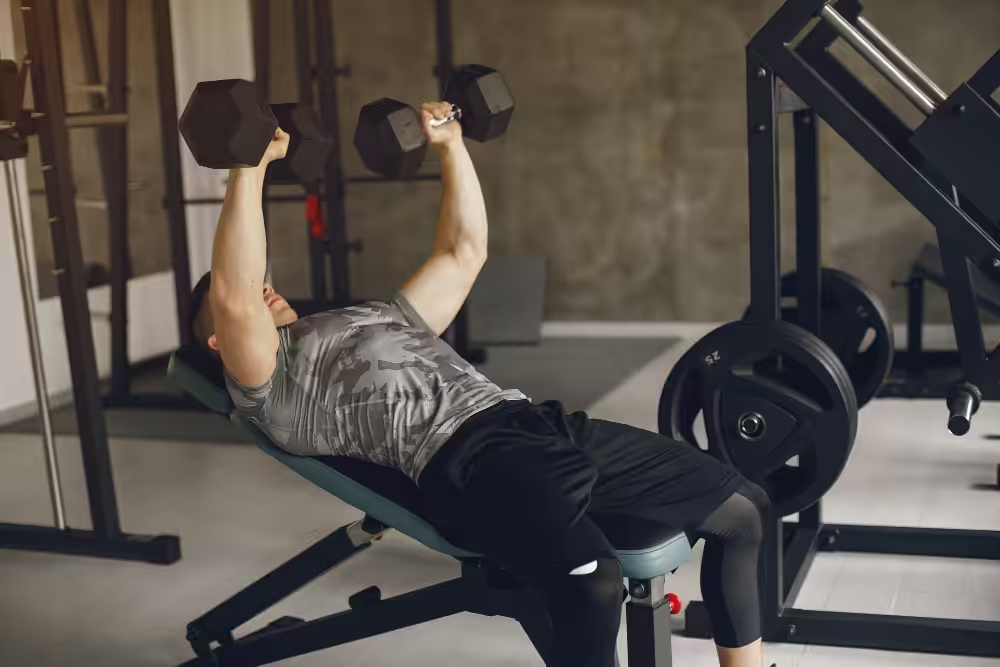
Dumbbells improve the mind–muscle connection because each limb works independently. You are forced to feel the target muscle doing the work instead of relying on momentum or compensation from the stronger side. This often leads to cleaner reps and better execution, especially on pressing and rowing movements.
When Barbells Are Better for Muscle Growth
Barbells allow progressive overload. Adding small weight increments is easier and more consistent with a barbell, which makes long-term progression more reliable. That steady increase in load is one of the strongest predictors of muscle growth.
Barbells also excel at heavy compound lifts. Movements like squats, deadlifts, presses, and rows allow you to involve large amounts of muscle mass at once.
Which Is Better for Strength?
When the goal is to move the heaviest possible weight, barbells are unmatched.
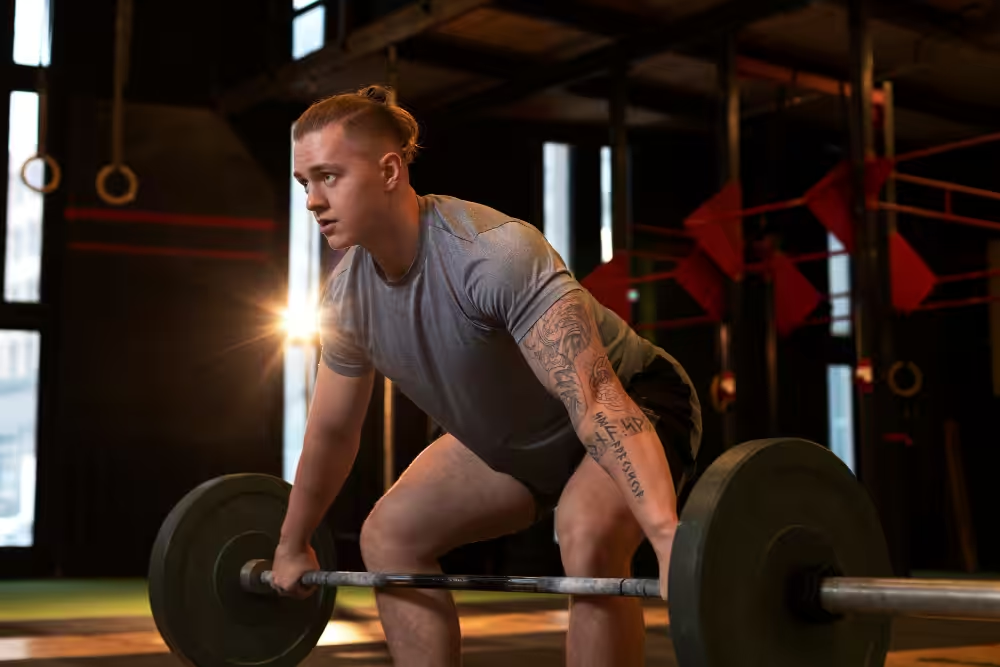
Classic lifts like squats, deadlifts, and presses are built around the barbell for a reason. The bar allows you to use your entire body to create tension and drive force efficiently. This makes it possible to lift loads that are simply not realistic with dumbbells.
Barbells also excel at load progression efficiency. You can increase weight in small steps, which makes long-term strength gains easier to plan and track. For anyone focused on maximal strength, the barbell is a must-do.
So… Which One Should You Choose?
If your main goal is to build muscle and you are not interested in lifting very heavy weights, dumbbells are a great choice. For many lifters, that is more than enough to build size and improve overall physique.
If your goal is to build functional strength, heavy free-weight lifts need to be part of your program. You will want to do movements like squats, deadlifts, and presses.
That said, we strongly recommend a mixed approach, so you can make room for both dumbbells and barbells. You can use dumbbells for exercises that feel better on your joints, and use barbells when you want to load heavy and train big compound movements.
You can also rotate variations based on preference and recovery. One week you might bench press with dumbbells, the next week use a barbell for flat bench and dumbbells for incline work. For your back, you might deadlift one session and use heavy dumbbell rows in another. You always have options.
The key is choosing exercises and loading methods that feel good for your body and let you train hard without putting you in awkward or risky positions.
FAQ
Can I do compound movements with dumbbells?
Yes, you can perform compound movements with dumbbells. There are dumbbell variations for presses, squats, hinges, and rows. However, you will not be able to stack as much weight as you can with a barbell. That makes dumbbells better for control and muscle tension, but less effective for maximal loading.
Are dumbbells safer than barbells?
In some situations, dumbbells can be safer because the loads are usually lighter and easier to manage. That said, they are not risk-free. If you lift beyond your ability, skip proper warm-ups, or lose control, you can get injured just as easily as with barbells. Safety depends more on execution and judgment than the tool itself.
Do dumbbells help fix muscle imbalances?
Dumbbells are very effective for correcting muscle imbalances because each side of the body works with the same load. One side cannot compensate for the other, which forces weaker muscles to catch up over time.